

Solar power in Britain is having quite a year.
Nearly 172,000 solar installations were completed across the UK between January and July 2026, according to government figures. July alone saw nearly 28,000 installations across homes, businesses and larger projects, making it the third-highest month on record. More than 19,800 of those July installations were rooftop systems.
That’s a lot of panels.
But behind every installation is another part of the story that receives far less attention:
Who is actually installing all of this solar?
Where are those businesses based? How many specialise solely in Solar PV? How many also install batteries, heat pumps or EV chargers? And what does the installer landscape look like if you’re a manufacturer, distributor or service provider trying to work with the UK solar industry?
We decided to dig into the data.
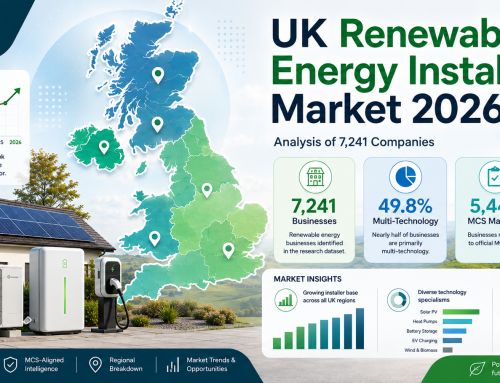
Using the Bitrixa UK Renewable Energy Installer & Supplier Database, we analysed a research-enriched dataset of 7,241 renewable-energy businesses.
Solar appeared almost everywhere.
Solar PV appears in 5,728 businesses in our dataset
Of the 7,241 renewable-energy businesses analysed, 5,728 list Solar PV somewhere within their technologies or services.
That’s approximately 79.1% of the entire dataset.
At first glance, you might assume that means Britain has thousands of businesses simply described as solar installers.
Not quite.
Only 2,236 businesses have Solar PV as their primary technology.
The remaining 3,492 solar-related businesses — 61% of the solar segment — are primarily classified as Multi-Technology.
| Solar market finding | Businesses | Share |
|---|---|---|
| Solar PV appears in technologies/services | 5,728 | 100% of solar segment |
| Primarily Solar PV | 2,236 | 39.0% |
| Solar PV within Multi-Technology businesses | 3,492 | 61.0% |
| Installer only | 4,462 | 77.9% |
| Installer & supplier | 1,080 | 18.9% |
| Supplier only | 186 | 3.2% |
| Official MCS directory matches | 4,262 | 74.4% |
This distinction turns out to be rather important.
Britain’s solar installer isn’t necessarily just a solar installer
Picture a solar installation business and you may imagine a company whose vans, website and entire operation revolve around photovoltaic panels.
Plenty do.
But our data suggests that the modern UK solar market is considerably more interconnected.
A business installing Solar PV today may also install battery storage. It may employ electricians who fit EV chargers. It may have expanded into air source heat pumps. It may supply equipment as well as installing it.
In fact, among the 5,728 businesses where Solar PV appears, only 39% are primarily classified as Solar PV businesses.
The majority fall under Multi-Technology.
That’s one of the biggest lessons from the research:
Searching only for businesses labelled “solar installer” can give you a surprisingly incomplete picture of the UK solar supply chain.
If you’re selling equipment or services into this market, what a company also installs can matter just as much as its primary label.
Solar and batteries are becoming difficult to separate
The strongest technology crossover in the database is between Solar PV and Battery Storage.
Of the 5,728 solar-related businesses analysed:
2,819 also list Battery Storage.
That’s 49.2%.
Almost one in two.
That is a sizeable overlap.
Solar panels produce electricity when the sun is available; batteries allow some of that electricity to be stored for use at another time. So it is hardly surprising that the technologies make commercial sense together.
What’s more interesting is how clearly that relationship appears when looking at the businesses serving the market.
For manufacturers and distributors, this means the traditional categories of “solar company” and “battery company” are increasingly blurred.
For an installer, adding storage can increase the range of systems it can offer.
For a battery manufacturer, meanwhile, solar installers represent an obvious potential distribution and installation network.
And for consumers, a conversation that starts with solar increasingly has the potential to become a conversation about the wider energy system of the home.
Solar is crossing into heat pumps too
Batteries aren’t the only crossover.
Our analysis identified 1,047 businesses offering both Solar PV and Air Source Heat Pumps.
That represents approximately 18.3% of the solar-related businesses in the dataset.
Another 292 solar businesses also list Ground or Water Source Heat Pumps.
Again, the interesting part isn’t simply the number.
It’s what the number says about how this market is changing.
Solar generates electricity.
A heat pump uses electricity to provide heating.
Add battery storage and potentially an EV charger, and a business that may once have installed one technology can now find itself helping customers think about much more of their household energy consumption.
That creates a very different renewable-energy business from the specialist solar installer of a decade ago.
And then there are EV chargers
We also identified 443 solar-related businesses offering EV Charging among their technologies or services.
That’s around 7.7% of the solar segment.
It is smaller than the solar-and-battery crossover, but commercially it is another logical combination.
A homeowner considering an electric vehicle may also start thinking about home charging and electricity costs.
A household installing solar might consider using some of its generation to charge an EV.
An electrical contractor already working with solar may have the technical skills and customer base to expand into charging infrastructure.
The point is not that every solar installer needs to provide every technology.
It’s that the boundaries between these markets are increasingly porous.
Solar-related technology overlaps in our dataset
| Additional technology/service | Solar-related businesses | Share of solar segment |
|---|---|---|
| Battery Storage | 2,819 | 49.2% |
| Air Source Heat Pumps | 1,047 | 18.3% |
| EV Charging | 443 | 7.7% |
| Ground / Water Source Heat Pumps | 292 | 5.1% |
| Solar Thermal | 245 | 4.3% |
These categories can overlap, so they should not be added together.
A single company may appear in several of them.
So where are Britain’s solar businesses?
This is where things get particularly interesting.
Among businesses in our dataset where Solar PV appears as a technology or service, South East England contains the largest number, with 906 businesses.
The South West comes next with 775.
Then the North West with 637 and the East of England with 606.
Solar PV businesses by region
| Region | Businesses offering Solar PV | Primarily Solar PV |
|---|---|---|
| South East England | 906 | 323 |
| South West England | 775 | 341 |
| North West England | 637 | 251 |
| East of England | 606 | 230 |
| Scotland | 454 | 143 |
| Yorkshire and the Humber | 440 | 160 |
| Wales | 395 | 145 |
| West Midlands | 394 | 155 |
| East Midlands | 352 | 143 |
| London | 219 | 128 |
| North East England | 205 | 66 |
| Northern Ireland | 108 | 61 |
A further 232 solar-related businesses were located in England but could not confidently be assigned to one of the standard English regions in the final dataset. Five records were located in Crown Dependencies.
And there’s an interesting twist in the table.
If we consider all businesses offering Solar PV, the South East comes first.
But if we look only at businesses where Solar PV is the primary technology, the South West leads, with 341 businesses compared with the South East’s 323.
That’s a useful example of why defining your market matters.
“Businesses that install solar” and “businesses primarily focused on solar” are not necessarily the same audience.
Does the installer map resemble the installation map?
Conveniently, we now have something interesting to compare our findings with.
On 27 August 2026, the UK government published its first regional breakdown accompanying the latest solar deployment figures.
For installations completed during 2026 up to the end of July, the largest regional totals included:
- South East: 22,628 installations
- East of England: 18,109
- South West: 17,539
- East Midlands: 15,981
- North West: 15,927
The government also reported increases in solar installations across every UK nation and every English region over the preceding 12 months.
Now compare that with our five largest solar-business populations:
- South East
- South West
- North West
- East of England
- Scotland
Four regions — South East, South West, East of England and North West — appear near the top of both pictures.
We should be careful not to read too much into that.
Our database is a researched business dataset rather than a census of every solar installer, and deployment figures measure installations rather than installer locations. A company based in one region may also work extensively in neighbouring regions.
Still, the overlap is noteworthy.
It suggests that some of the parts of Britain currently seeing high solar deployment also support substantial installer ecosystems.
London is not the centre of this market
One figure that may surprise people is London.
Only 219 of the 5,728 solar-related businesses in the dataset are assigned to London.
That’s just 3.8%.
Compare that with:
- 906 in the South East
- 775 in the South West
- 637 in the North West
- 606 in the East of England
For businesses accustomed to treating London as the natural centre of almost every UK B2B campaign, renewable energy is a good reminder that markets don’t always work that way.
Installation businesses tend to exist where the work is.
For sales teams, distributors and manufacturers, that can make regional segmentation much more useful than a generic national campaign.
A company selling mounting equipment, inverters or batteries, for example, might want to prioritise regions with larger concentrations of relevant installers.
A training provider could look for areas where installer numbers and deployment are increasing.
A software provider serving field engineers may want a completely different subset.
Geography becomes another layer of targeting rather than simply an address field.
This is overwhelmingly an installer-led market
Among the 5,728 solar-related businesses:
4,462 are classified as installers.
Another 1,080 operate as both installers and suppliers.
Only 186 are classified purely as suppliers.
Put another way, 5,542 businesses — 96.8% of the solar-related dataset — have an installation role.
That has an important commercial implication.
If you’re trying to enter the UK solar supply chain, your addressable audience is not limited to a relatively small number of wholesalers and distributors.
Installers themselves influence which panels, inverters, mounting products, batteries, monitoring tools and supporting services reach the end customer.
And many installers are businesses in their own right with needs extending far beyond hardware.
They buy:
- software
- insurance
- vehicles
- finance
- training
- certification support
- recruitment services
- digital marketing
- electrical components
- mounting systems
- batteries
- monitoring equipment
- tools and safety equipment
The solar economy extends well beyond solar panels.
What about MCS?
MCS is another important part of the picture.
Of the 5,728 solar-related businesses in our research, 4,262 were matched to official MCS directory information.
That’s approximately 74.4%.
MCS defines an MCS Certified Installer as a business that has achieved and maintains certification for the design and/or installation of applicable low-carbon technologies and operates under the MCS Installer Agreement.
However, an important caution applies here.
A business in our dataset without an MCS directory match should not automatically be described as an uncertified solar installer.
Why?
Because this wider market includes suppliers, manufacturers, service businesses, companies sourced from non-MCS directories and businesses whose current certification status may require separate verification.
Our database therefore records an official MCS directory match where one was established rather than making assumptions about businesses that were not matched.
That’s a small distinction, but an important one when working with real business data.
Solar deployment is accelerating — and the installer network matters
The wider market backdrop explains why understanding these businesses is becoming increasingly useful.
The government’s Solar Roadmap calls for solar capacity to rise to 45–47 GW by 2030, from a little over 18 GW when the roadmap was prepared. It also estimates that solar could support up to 35,000 direct and indirect jobs in Great Britain by 2030.
The scale of recent deployment provides some idea of the challenge.
Government data show almost 172,000 installations in the first seven months of 2026 alone, with rooftop systems accounting for more than seven in ten installations during July.
Targets and gigawatts tend to dominate discussions about the energy transition.
But capacity doesn’t install itself.
Every extra rooftop system creates work somewhere in the chain:
surveying, system design, electrical installation, scaffolding, mounting, commissioning, certification, battery integration, maintenance and customer support.
That makes installer capacity — and the businesses behind it — an important part of the solar story.
What does all this mean for businesses selling into UK solar?
Perhaps the most useful conclusion from our analysis is also the simplest:
Don’t treat “solar installers” as one audience.
A manufacturer selling solar modules may want businesses with high Solar PV relevance.
A battery manufacturer may prefer the 2,819 businesses already combining Solar PV with Battery Storage.
An EV charging equipment company could investigate the 443 solar businesses also active in EV charging.
A heat-pump manufacturer might focus on the 1,047 businesses combining Solar PV and Air Source Heat Pumps.
A distributor could segment geographically.
A software business might care more about company size, installation activity and organisation type than the technology itself.
And a recruiter may be interested in businesses operating across several technologies because their skills requirements are likely to be broader.
One enormous list labelled “solar companies” doesn’t necessarily solve any of those problems.
Useful B2B data starts by asking:
Which solar businesses are actually relevant to what we’re selling?
The UK solar market is becoming an energy-services market
That may be the broader story hidden inside the numbers.
Solar remains at the centre — appearing in 5,728 of the 7,241 renewable-energy businesses we researched.
But around it, other technologies are increasingly appearing:
battery storage, heat pumps, EV charging and wider electrical services.
Almost half of the solar-related businesses in our dataset also list battery storage.
More than 1,000 also list air source heat pumps.
And 61% of businesses offering solar are primarily classified not as Solar PV specialists, but as Multi-Technology businesses.
The installer installing panels today may increasingly become the company helping a customer manage several parts of their energy system tomorrow.
For consumers, that could make buying renewable technologies more joined-up.
For manufacturers and suppliers, it changes who their potential customers are.
And for anybody trying to understand the UK solar industry, it means the market is considerably more interesting than a simple list of solar-panel companies.
About this research
This analysis uses the Bitrixa UK Renewable Energy Installer & Supplier Database, a research-enriched dataset containing 7,241 businesses across 33 structured fields.
The database was assembled and enriched from multiple public and official information sources, including MCS information, Companies House research, company websites and supporting public evidence.
For this article, a business was included in the solar analysis where Solar PV appears within its recorded Technologies / Services field.
That produced a solar-related population of 5,728 businesses.
The figures should not be interpreted as an official census of every Solar PV installer operating in the United Kingdom. Businesses enter and leave markets, service offerings change and certifications and contact information can be updated.
The analysis is instead intended to provide a large, structured snapshot of the UK installer and supplier landscape.
Looking for the underlying UK solar business data?
The full Bitrixa UK Renewable Energy Installer & Supplier Database contains 7,241 researched businesses covering Solar PV, battery storage, heat pumps, EV charging and other renewable technologies.
It includes technology classifications, installer/supplier roles, websites, business emails, telephone numbers, geographic information, MCS data, Companies House research, accreditations and supporting evidence.
For manufacturers, suppliers, software companies, recruiters, consultants and other organisations researching or selling into the UK renewable-energy sector, the dataset makes it possible to segment the market far beyond a simple search for “solar installers”.
Explore the UK Renewable Energy Installer & Supplier Database



Leave A Comment